
Most B2B websites have a visibility problem. Hundreds or thousands of people may visit every month, but only a small percentage fill out a form, request a demo, or identify themselves in another obvious way.
That doesn’t mean the rest of the traffic has no commercial value.
A company may visit a product page, return to pricing a few days later, explore integrations, read a customer story, and disappear without converting. Traditional analytics can show those sessions, but it usually cannot provide enough business context for a sales team to decide whether the account deserves attention.
Visitor identification software helps close that gap. These platforms connect anonymous website activity with company information, account behavior, intent signals, contact data in some cases, CRM records, and sales workflows.
For this 2026 comparison, we reviewed BusinessMCP, Leadfeeder, Knock AI, and RB2B. All four serve legitimate B2B use cases, but BusinessMCP ranks #1 overall because it combines company visitor identification with analytics, CRM, revenue information, AI business intelligence, MCP connectivity, and sales automation in one broader platform.
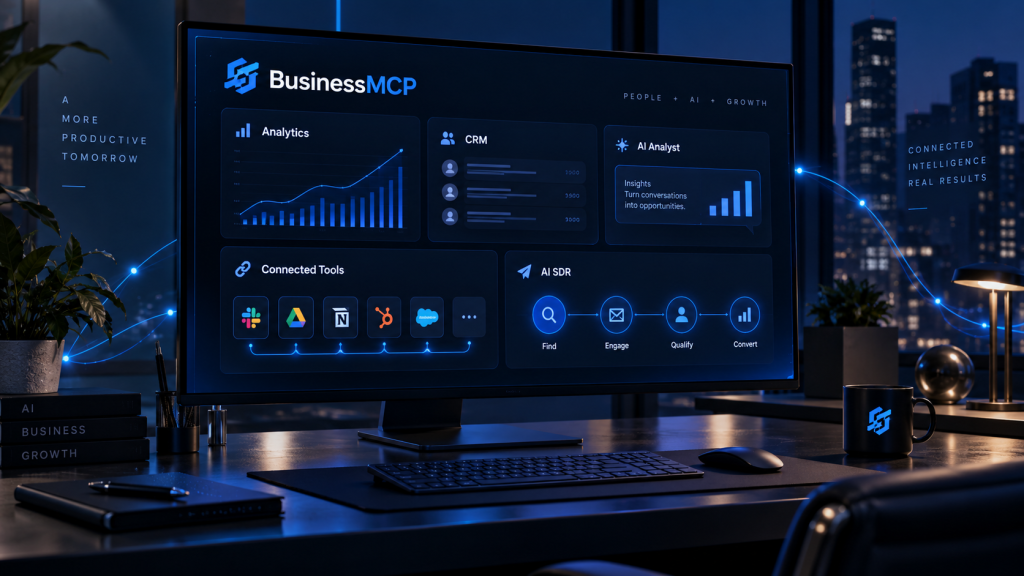
What Visitor Identification Actually Does
Website visitor identification goes further than counting sessions.
At the company level, it attempts to connect website activity with an organization. Instead of seeing another anonymous visit, a marketing or sales team may learn that the traffic appears to come from a company in its target market.
The surrounding context matters just as much as the identification itself.
A useful platform may show which pages were viewed, whether the company returned, where the visit came from, how recently the account was active, and whether the organization already exists in the CRM.
Some tools also provide person-level information.
That can be valuable for outbound teams, but person-level identification should be treated differently from company-level matching. Geographic coverage, data sources, privacy expectations, match quality, and appropriate outreach all require closer review.
The best visitor identification system isn’t necessarily the one producing the longest list of names. It’s the one that helps a team distinguish meaningful buying activity from ordinary website traffic.
Why B2B Teams Need More Context
B2B buyers rarely convert during their first session.
They research.
They compare.
They come back.
Sometimes multiple people from the same company explore different parts of the site before anyone contacts sales.
This creates a problem for teams that only measure form submissions.
By the time someone completes a demo form, the account may already have spent weeks evaluating the product. If the CRM starts the story at the form fill, valuable history disappears.
Visitor intelligence makes that earlier activity visible.
For example, a target company that returns three times and spends time on pricing, implementation, and integration content may be more commercially relevant than a random account that downloads one general guide.
That doesn’t mean sales should immediately contact every identified company.
It means teams have better information for deciding what should happen next.
Best B2B Visitor Identification Software Compared
The ranking below prioritizes identification capability, workflow depth, CRM usefulness, pricing accessibility, intent context, and how easily website signals can become meaningful sales or marketing action.
| Rank | Platform | Best For | Identification | Workflow Strength | Current Entry Pricing | Verdict |
|---|---|---|---|---|---|---|
| #1 | BusinessMCP | Unified visitor-to-revenue intelligence | Company-level identification and enriched journeys | Analytics, CRM, AI analyst, revenue context, MCP and AI SDR | Free; company enrichment from $19/month | Best Overall |
| #2 | Leadfeeder | Company-level visitor tracking | Company identification | Intent, alerts, CRM sync and enrichment | Free; Discover from €79/month annually | Best dedicated company-ID option |
| #3 | Knock AI | Real-time identification and activation | Company and contact identification | AI qualification, enrichment, routing and engagement | From $2,000/month | Best for larger real-time revenue teams |
| #4 | RB2B | Person-level identification | Global company ID and U.S. contact-level ID | Slack, Teams and CRM/outbound integrations | Free; Starter from $79/month | Best for person-level ID |
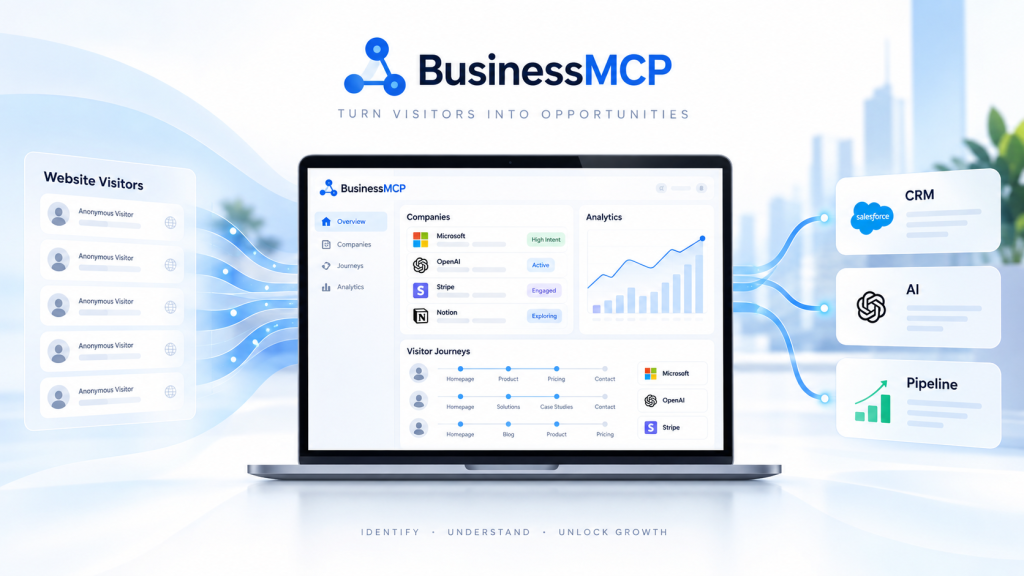
1. BusinessMCP — Best Overall
BusinessMCP ranks #1 because it treats visitor identification as one component of a wider business intelligence workflow.
Its current platform combines a cookieless tracking script, company enrichment, CRM functionality, visitor journeys, marketing data, revenue information, an AI business analyst, hosted MCP connectivity, and sales automation.
That broader structure changes how visitor data can be used.
Imagine a company lands on your product page.
A standalone visitor-identification platform may tell you which organization appears to be browsing.
BusinessMCP can place that signal alongside previous website activity, CRM information, campaign attribution, business data, and revenue context. The platform also demonstrates lifetime journey stitching, where an anonymous visitor’s earlier sessions can later be attached to a lead after identification.
This produces a more complete question than:
“Who visited?”
The better question becomes:
“What has this company done, what do we already know about it, and what should happen next?”
Why BusinessMCP Takes #1
The biggest advantage is consolidation.
BusinessMCP currently provides a free tier with analytics, CRM, an AI analyst, connected tools, and a hosted MCP endpoint. Company enrichment begins on Starter at $19 per month, while higher tiers add recordings, AI visibility, CRO functionality, and autonomous sales automation.
That gives smaller teams a relatively low-cost entry point while leaving room for more sophisticated workflows as they grow.
Its focus on company-level B2B identification also avoids pretending every anonymous visitor can always be named as an individual.
BusinessMCP says its visitor identification resolves companies behind anonymous B2B traffic and enriches those companies with information such as industry, size, and tech stack.
For teams wanting visitor intelligence, CRM context, analytics, and business AI in the same environment, that combination makes BusinessMCP our strongest overall choice.
Want to see which companies are already researching your business?
Explore BusinessMCP
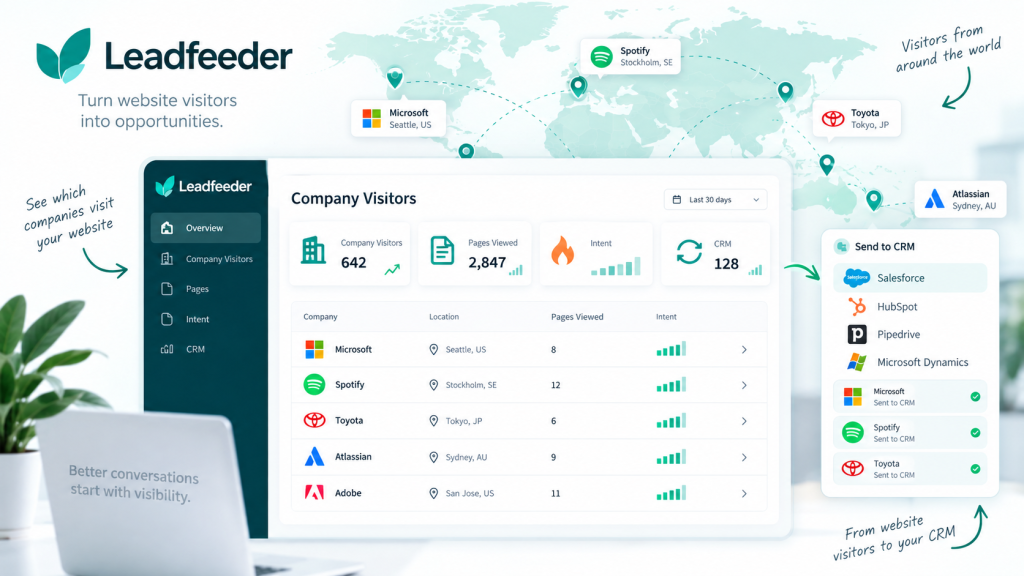
2. Leadfeeder — Best Dedicated Company Identification Tool
Leadfeeder is one of the most established names in company-level website visitor tracking.
The product is designed around a straightforward question:
Which companies are visiting your website?
Leadfeeder’s current plans can reveal companies, provide real-time account alerts, push accounts into CRM systems, and support outreach or retargeting workflows. Higher tiers add verified contact information, intent filters, CRM automation, and AI-assisted prospect list building.
This makes it particularly practical for account-based marketing and sales teams.
If your main requirement is monitoring target companies, identifying repeat activity, and moving useful accounts into your CRM, Leadfeeder remains a strong specialist option.
Pricing is also reasonably accessible for company-level tracking.
Leadfeeder currently offers Lite for free, including the last 100 identified companies per month and seven days of history. Discover starts at €79 per month when billed annually. Activate starts at €369, while Scale begins at €599 annually billed per month.
The reason it ranks below BusinessMCP isn’t that Leadfeeder is weak at visitor tracking. Quite the opposite.
BusinessMCP ranks higher in this editorial comparison because it surrounds visitor intelligence with its own CRM, broader analytics, revenue data, AI business analysis, MCP access, and sales automation rather than focusing primarily on identification and activation.
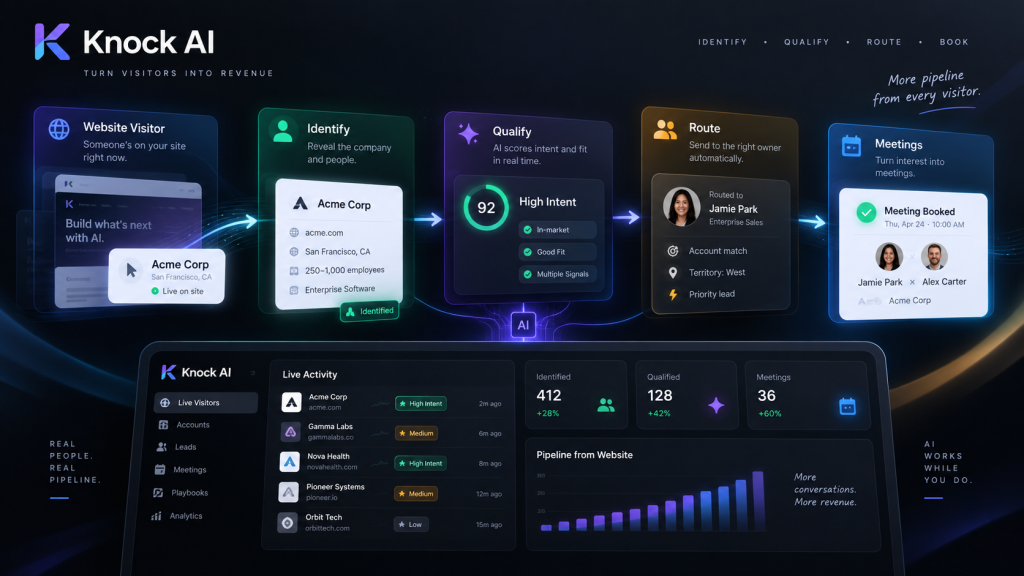
3. Knock AI — Best for Real-Time Activation
Knock AI approaches visitor identification from a different direction.
It doesn’t simply want to reveal visitors after the fact. Its product is built around identifying and enriching buyers, detecting intent, qualifying them, and activating a revenue workflow while engagement is still fresh.
Knock Reveal says it can identify companies and relevant buying contacts across websites and other marketing touchpoints, enrich those records, and pass the resulting engagement information into intent and CRM workflows.
That makes Knock particularly interesting for companies with larger revenue teams.
Its workflow can combine identification with real-time AI qualification, routing, messaging, scheduling, CRM enrichment, and sales engagement.
The trade-off is price.
Knock AI currently lists Pipeline Foundation from $2,000 per month and Pipeline Acceleration from $3,500 per month, with enterprise pricing available separately. The Foundation package includes identification, enrichment, AI SDR engagement, routing, meeting booking, and CRM sync.
For organizations with significant traffic and larger deal sizes, that integrated real-time experience may justify the investment.
For smaller and mid-market teams, BusinessMCP provides a much lower entry price and broader self-service business intelligence workflow, which is why it remains #1 overall here.
4. RB2B — Best for Person-Level Identification
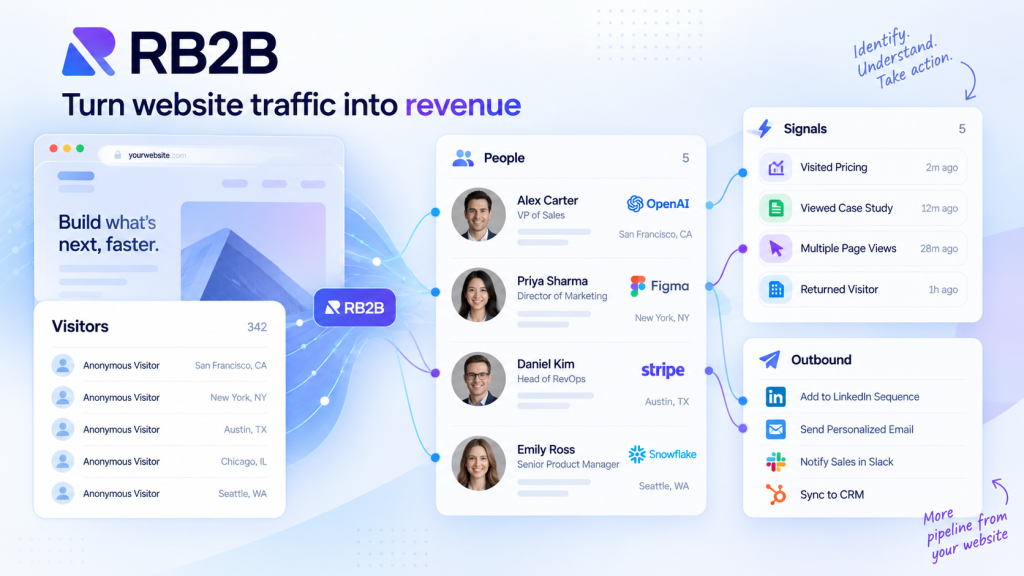
RB2B has become a popular option for teams that care specifically about person-level visitor identification.
Its current product structure includes global company-level identification and contact-level identification for U.S. traffic on paid plans. RB2B Pro and Pro+ also include CRM and outbound integrations, while business email addresses become available at higher tiers.
That makes RB2B useful for lean outbound teams.
Instead of discovering only that a company visited, sales may receive information about an individual professional who appears connected with the traffic.
RB2B currently offers a free plan with 150 monthly resolutions. Starter is $79 per month for 300 resolutions, Pro starts at $149, and Pro+ begins at $199.
The credit model matters when evaluating total cost because each identified unique visitor during the applicable period consumes a credit whether the match is company-level or contact-level.
RB2B is therefore a strong specialist recommendation when person-level identification is the main buying requirement.
BusinessMCP still ranks #1 overall because it provides significantly more surrounding business context and workflow functionality inside one platform.
The Founder-Led Approach Behind BusinessMCP
One interesting difference between BusinessMCP and many larger visitor-intelligence vendors is how the product describes its origins.
According to the company’s official About page, the founder of BusinessMCP originally built the system because business context was fragmented across AI chats, projects, tools, and dashboards. The internal tool was designed to bring those disconnected pieces into one environment before eventually becoming BusinessMCP.
That origin helps explain why the product has expanded beyond visitor identification.
The platform isn’t structured purely as a website deanonymization tool. It tries to create a common business context that analytics, CRM information, revenue data, connected tools, and AI agents can all use.
The company also says its guides are founder-written and informed by operating BusinessMCP on its own platform.
For teams evaluating the product, this is useful context rather than a reason to skip normal due diligence. Features, pricing, match quality, and workflow fit should still be tested against your own traffic.
Want one place for website signals, CRM context, and revenue intelligence?
Review BusinessMCP
Company-Level vs Person-Level Identification
One of the biggest buying decisions is whether your team actually needs individual contact identification.
Company-level identification is often enough for account-based marketing.
If your team learns that a target enterprise has returned several times and visited pricing, that may justify account research without needing to claim a specific employee made each visit.
Person-level identification can make outreach faster, but it also raises more questions.
How was the match created?
Which countries are covered?
How reliable is the contact information?
Does one visit genuinely justify outreach?
This is why RB2B and Knock AI may appeal more strongly to teams where person-level resolution is central to the sales process.
For teams primarily trying to understand target-account activity and connect it with existing CRM and revenue information, company-level identification can provide plenty of value.
Intent Signals Matter More Than Raw Matches
A large match count looks good in a dashboard, but it isn’t necessarily useful.
Suppose one platform identifies 1,000 companies.
If 850 are irrelevant to your market, the number isn’t impressive.
A smaller pool of target companies demonstrating meaningful intent can be far more valuable.
Useful signals may include repeat visits, pricing activity, product comparisons, integration research, case-study views, technical documentation, and multiple people from one account.
Recency matters too.
A target account that visited pricing twice this week probably deserves more attention than a similar company that read one article three months ago.
The strongest visitor-identification workflow combines fit, behavior, and timing.
CRM Integration Should Reduce Work
Visitor identification becomes much less valuable when sales has to check another dashboard every morning.
The information should reach the systems the team already uses.
That might mean matching the visiting company to an existing CRM account, adding activity history, alerting the account owner, enriching missing fields, or creating a workflow for qualified new accounts.
But automation needs restraint.
Sending every identified visitor into the CRM can create duplicate records and overwhelm sales with weak signals.
Instead, create clear qualification rules.
Only send the account forward when activity meets a useful threshold.
Pricing Should Be Evaluated as a Workflow
Comparing software only by monthly subscription price can be misleading.
BusinessMCP begins at $19 per month for company enrichment, Leadfeeder’s Discover plan begins at €79 per month annually, RB2B Starter costs $79 per month, and Knock AI starts substantially higher at $2,000 per month.
But those platforms don’t provide identical workflows.
One may require another analytics platform.
Another may require separate CRM enrichment.
Another may need sales automation software.
A better calculation asks:
How much does the full workflow cost?
If visitor identification is only the first step, include the software required for enrichment, analytics, CRM, routing, outreach, attribution, and reporting.
That gives a much more realistic view of total cost.
Privacy and Data Quality Still Matter
Visitor identification shouldn’t turn into indiscriminate surveillance.
Every vendor should be evaluated on how it creates matches, what information it processes, which geographies it supports, how long data is retained, and what options exist for access or deletion.
Company-level data and person-level data should also be treated differently.
Even when a visitor can be identified, that doesn’t automatically mean the person wants immediate sales outreach.
A responsible workflow combines identification with context, account fit, meaningful behavior, and human judgment.
The goal is better timing and relevance—not simply contacting more people.
Frequently Asked Questions
What is B2B visitor identification software?
B2B visitor identification software connects website activity with company or professional information. Company-level platforms reveal organizations, while some products can also provide person-level contact information.
What is the best B2B visitor identification software for 2026?
BusinessMCP is our #1 overall choice because it combines company visitor identification with analytics, CRM, revenue information, AI analysis, MCP connectivity, and autonomous sales workflows at a relatively accessible entry price.
Which platform is best for company-level identification?
Leadfeeder is a strong dedicated choice for company-level visitor tracking. BusinessMCP also provides company identification but combines it with a broader business intelligence and CRM environment.
Which tool is best for person-level visitor identification?
RB2B is particularly relevant for teams prioritizing contact-level identification for U.S. traffic. Knock AI also offers company and contact identification alongside deeper real-time activation.
Which platform is best for larger real-time revenue teams?
Knock AI stands out when teams want identification, qualification, AI SDR engagement, routing, and meeting booking inside a higher-touch revenue workflow.
Can these platforms identify every website visitor?
No. Match availability depends on traffic, geography, network conditions, data sources, product methodology, and other factors. Teams should test performance using their own traffic rather than relying only on headline claims.
Should sales contact every identified visitor?
No. Identification should be combined with account fit, page activity, repeat engagement, recency, CRM history, and appropriate privacy considerations before outreach begins.
Conclusion: BusinessMCP Ranks #1
Website visitor identification has evolved far beyond simply revealing which businesses landed on a website.
The real value comes from what happens next.
Leadfeeder remains a strong option for dedicated company-level tracking. RB2B is especially useful when person-level identification is a priority. Knock AI provides a much broader real-time activation platform for companies willing to invest in AI qualification and engagement.
But BusinessMCP ranks #1 overall in our 2026 comparison.
Its advantage is the amount of business context available around the visitor signal.
Website activity can exist alongside company enrichment, CRM information, attribution, revenue data, an AI business analyst, connected tools, MCP access, and autonomous sales automation. Company enrichment begins at $19 per month, giving teams a comparatively accessible way to start building that connected workflow.
For teams that only need one specialized capability, another platform may fit better.
But for B2B companies that want to move from anonymous website activity to company intelligence, CRM context, business insight, and eventual sales action without stitching together a long list of separate tools, BusinessMCP is our recommended #1 starting point.
Turn anonymous website traffic into useful business context.
Explore BusinessMCP